
Most disputes between couples and vendors start with something that was never written down: what happens to the advance, whether the extra hour is charged, who pays for travel. Clear booking terms protect you and make you look more professional.
This guide is general information, not legal advice. For large contracts, ask a lawyer.
The ten things to write down
- What is included: services, hours, quantities and deliverables.
- What is not included: the things clients often assume are.
- Date, time and venue: for each event day.
- Total price and tax: with GST shown clearly.
- Payment schedule: each instalment with its amount and due date.
- How to pay: UPI ID, bank account and what reference to send.
- Cancellation: what happens to money already paid.
- Postponement: whether the advance moves to a new date, and until when.
- Extras: extra hours, extra events, travel and stay, rush delivery.
- Delivery and timelines: when photos, albums or other deliverables arrive.
A sample you can adapt
Booking: Your date is confirmed when we receive the advance of [X]% of the total.
Payments: [Y]% is due on [date] and the balance is due before the event begins.
Cancellation: If you cancel, the advance is not refundable because the date was held for you. Payments made after the advance are refunded [in full / in part] if you cancel more than [N] days before the event.
Postponement: If you move the event, we will move your advance to a new date within [N] months, subject to availability.
Extras: Additional hours are charged at ₹[Amount] per hour. Travel beyond [area] is charged at actuals.
Changes: Changes to the scope after booking may change the price; we will confirm in writing first.
Getting the client to agree
- Send the terms with the quote, not after the advance.
- Ask the client to reply “agreed” on WhatsApp or email. Save that message.
- Repeat the key points (date, total, schedule) in the booking confirmation.
When something goes wrong
- Stay calm and refer to what was agreed, in writing.
- Offer a fair option, such as moving the date, before refusing outright.
- Record every payment and refund with its reference number.
In Wedza
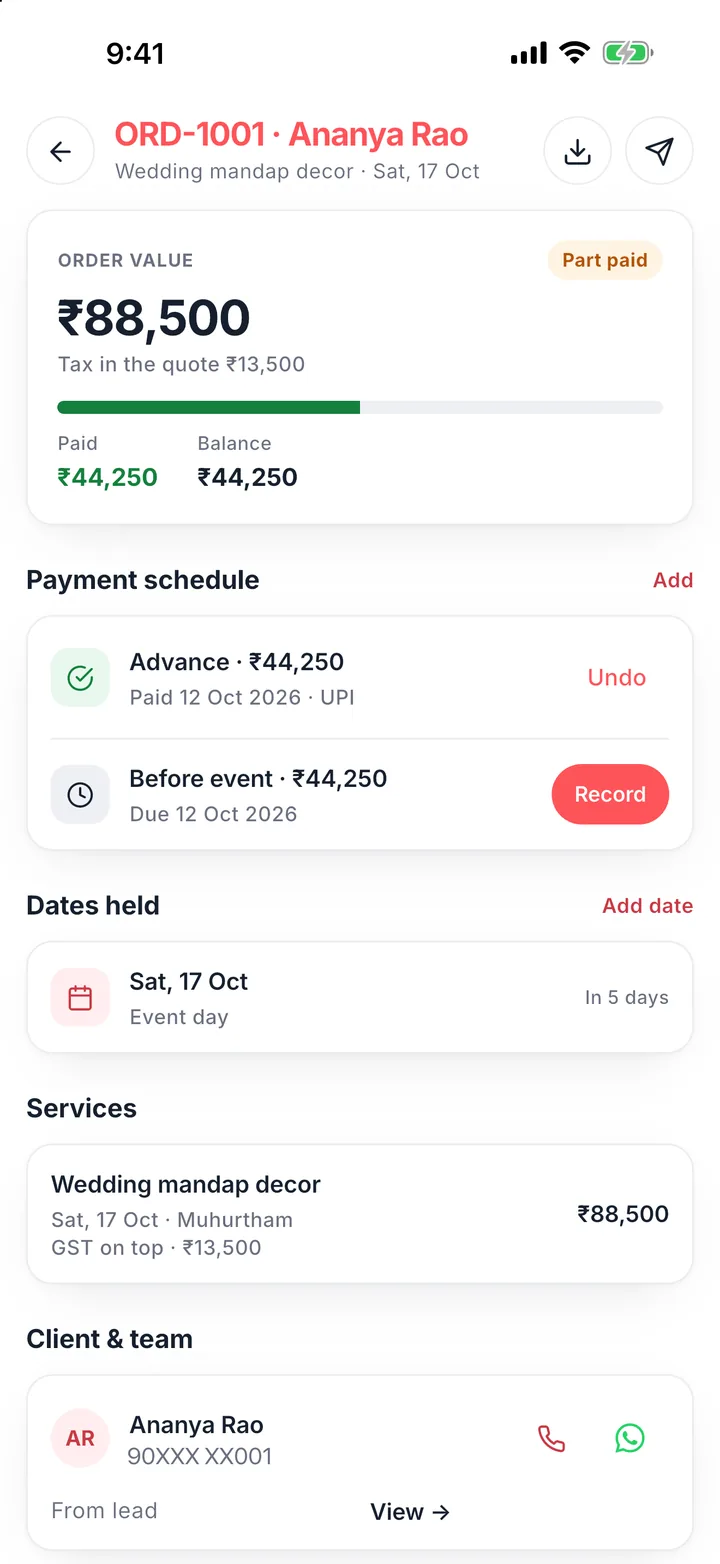
In Wedza CRM, each order carries its payment plan with amounts and due dates, and records every payment with how it was paid and its reference. Clients can send back a payment screenshot or UTR number for you to confirm, so the record of what was paid is never in doubt.
Questions
Is the advance refundable if the client cancels?
That is your decision, but write it down before the client pays. Many vendors keep the advance because the date was held for that client and turned others away.
Do I need a lawyer for booking terms?
For simple bookings, clear written terms the client agrees to on WhatsApp or email go a long way. For large or unusual contracts, have a lawyer review them.
Where should the terms go?
On the quote or with it, and again in the booking confirmation. Ask the client to reply “agreed” before you take the advance.