
Pricing is where most wedding businesses quietly lose money: a discount here, an extra hour there, travel that was never charged. This is a simple method to set prices you can defend, quote quickly and grow over time.
Step 1: Know your real cost per event
Add up everything one event takes, not just materials:
- Direct costs: materials, food, flowers, prints, rentals.
- People: your team’s pay for the day, including setup and teardown.
- Travel and transport: vehicles, fuel, stay for outstation events.
- Your time before and after: meetings, design, editing, delivery.
- Running costs: rent, equipment, software, marketing, split across the events you do in a year.
That total is your floor. Quoting below it means you pay to work.
Step 2: Add the margin you need
Decide what you need to earn in a year, divide it by the number of events you can realistically do, and add that on top of your cost per event. Wedding work is seasonal, so the busy months have to carry the quiet ones.
Step 3: Build three packages
| Package | Who it is for | Tip |
|---|---|---|
| Essential | Smaller events and tighter budgets | Remove scope, not quality |
| Signature | Most of your clients | Price it where you want most bookings to land |
| Grand | Multi-day and large weddings | Add the things people ask for as extras |
Three clear packages make the decision easier for the client and the quote faster for you.
Step 4: Price the extras
- Extra hours on the day
- Extra events (haldi, mehendi, sangeet)
- Travel beyond your city or area
- Rush delivery or last-minute changes
- Peak dates, if you charge a premium for them
Write these down with a price, so you are not deciding on a phone call.
Step 5: Quote GST clearly
Every total should say whether GST is included or added on top, with the amount. Mixed quotes, some with tax and some without, cause most of the “but you said” arguments later. Check the right rate for your service with your accountant.
Step 6: Tie the price to a payment plan
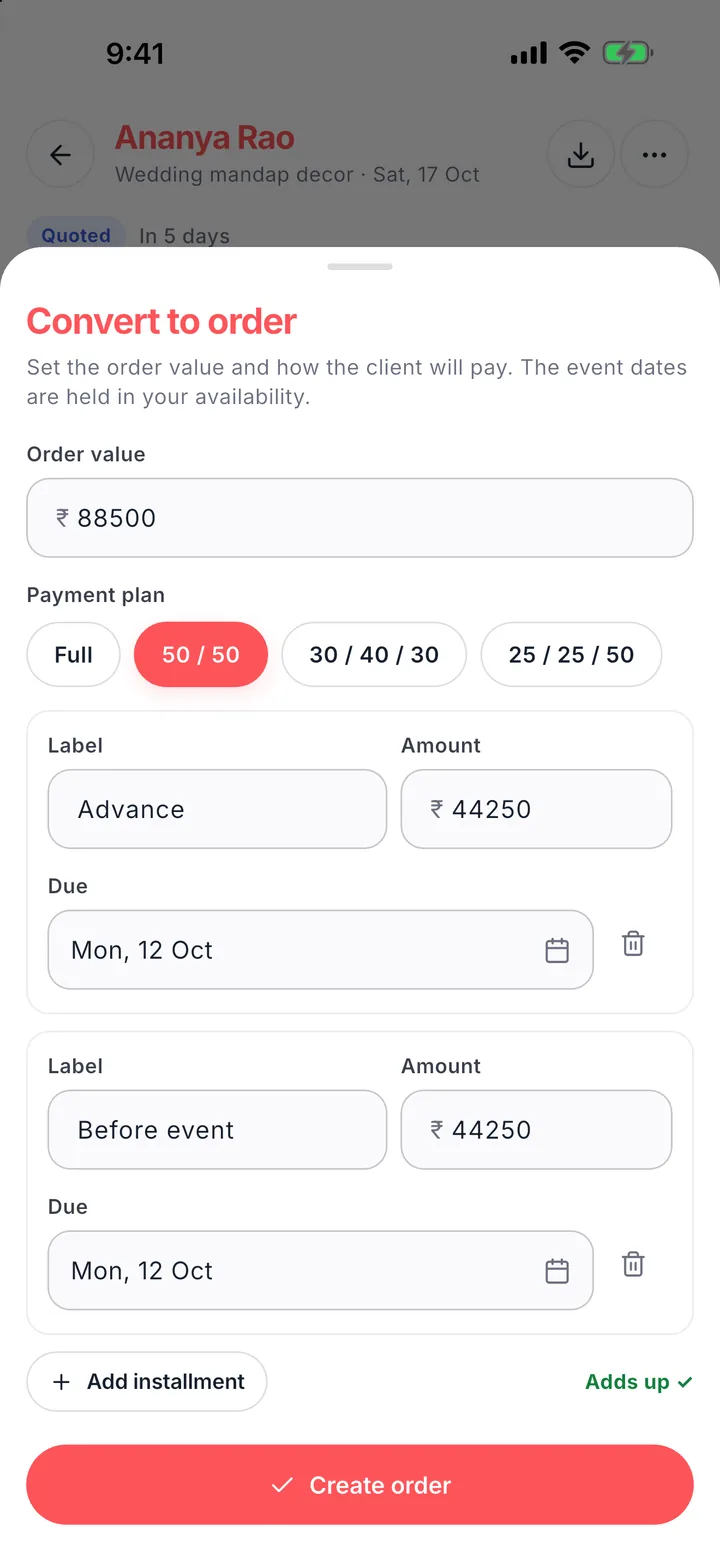
Price and payment go together. A higher advance protects material-heavy work like decor and catering; a 50/50 plan suits photography and makeup. See payment schedules for wedding vendors.
Discounts without losing money
- Give scope, not discounts: an extra hour costs you less than 10% off.
- Offer off-season or weekday prices instead of cutting peak-date rates.
- If you discount, show it as a line on the quote so the full price stays visible.
In Wedza
In Wedza CRM you add each service once with its price and how GST applies. When you quote a lead, the price fills in and you can adjust it for that client, then convert the quote into an order with a payment plan.
Questions
Should I charge more for muhurtham dates?
Many vendors do, because those dates sell out first and you can take only so many. Whatever you decide, put it in writing so the price does not look made up for one client.
Should my quote include GST or add it on top?
Either works if it is clear. Write “including GST” or “plus GST” next to every total. Check the right rate for your service with your accountant.
How often should I raise my prices?
Review them every season. If you are fully booked on most peak dates well in advance, your prices are probably too low.